
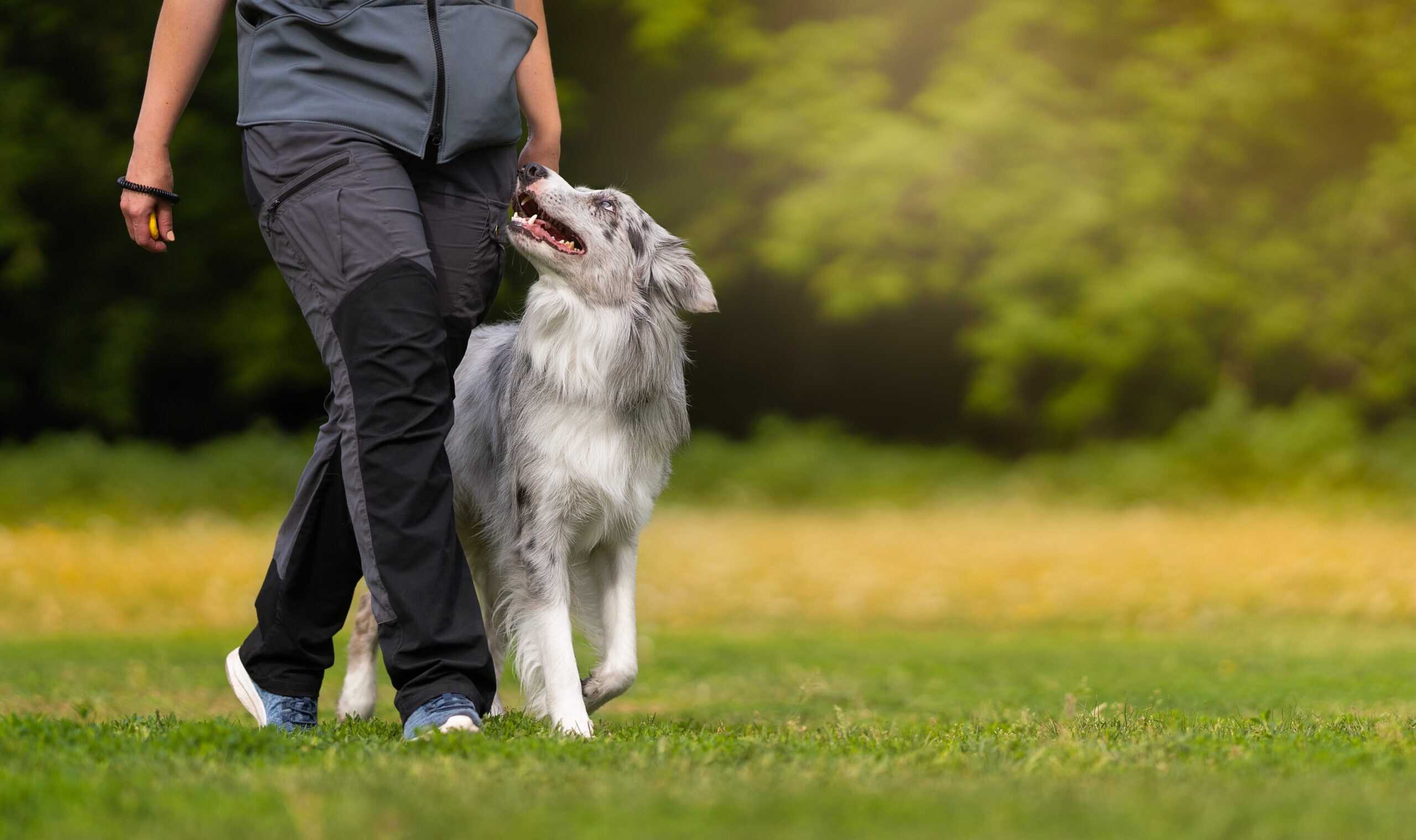
Have you ever been working with your dog, and something just isn’t clicking as you would anticipate? Perhaps it appears that they aren’t grasping an obedience command, or maybe they are simply inconsistent with responding to cues. They get frustrated. You get frustrated. Progress stalls.
As is often the case in dog training, the solution often lies with our own behavior towards our dogs. A critical component of dog training is timing – that is, communicating to our dog that they did (or didn’t) perform a behavior that we were asking them to do. In obedience training, we can frequently communicate this through praise or rewards.
In this article, we’re going to outline why timing is so important in dog training – and how you can avoid some of the common pitfalls and improve your own timing to achieve better outcomes with your dog.
How dogs learn
Before we talk about timing in detail, it is first important to understand how dogs actually learn. For dogs, there is a very clear relationship between an action and the corresponding consequence. To build strong behavioral habits in your dog through repetition, it is essential to pair your dog’s action with a corresponding outcome. In the early stages, this might be through constant reinforcement of a desirable behavior by providing treats or enthusiastic praise.
At its most basic level, the following framework is a good way to think about how your dog learns:
Request —> Response —> Outcome
To use a common example, let’s imagine you want your dog to perform the Down command. You tell them to do this by saying “Down” (Request); your dog then obeys the request by getting into the Down position (Response); the outcome is that the dog receives a reward (Outcome). When you first teach a behavior or command to your dog, this is how your dog builds the habits to respond to your instructions. This process is commonly referred to as operant conditioning.
Why timing is everything
Timing is pivotal in dog training because the relationship between action and consequence is immediate in your dog’s brain. If the Outcome phase isn’t aligned immediately with the Response phase, it can lead to confusion.
For example, if your dog does perform the behavior, but you reward too late (ex: after they have stood up from the Down they performed), they may associate the reward with the wrong behavior. The same can happen if you reward too abruptly. Often, one reason that undesirable behaviors persist is because behavior improvements are not happening ‘in the moment’ – it is no good trying to tell your dog that they shouldn’t have jumped on the counter and consumed an entire Thanksgiving roast if it happened twenty minutes ago. You need to catch that behavior when it is occurring to correct it effectively.
This is very different to how humans see and interpret the world. For humans, there can be a delay between the Request, Response and Outcome phases. If you tell your child to tidy their room (Request), they may not tidy it immediately (Response), but they might do it in an hour’s time, and you may give them an allowance or other treat as a reward (Outcome). It doesn’t have to happen immediately for the child to understand the nature of the request, decide how to respond to it, and evaluate the potential consequences.
Common issues with timing
When we observe dog owners interacting with their dogs, there are a few common issues that arise. These usually aren’t intentional! If you haven’t been taught the importance of timing, then you don’t know it is something you need to focus on. Here are some of the commonalities:
- Delaying rewards or corrections. As we mentioned above, you have to respond at the right time – in other words, when your dog does (or doesn’t) follow your request.
- Correcting ‘after the fact’. Your dog doesn’t comprehend that, two hours ago, they did something you didn’t want them to do. This is likely to confuse or cause anxiety in your dog.
- Unclear communication. When working with your dog, clear communication is essential. Talking too much can obfuscate your true goal and result in your command or cue being lost in the shuffle. Body language cues should also be consistent.
- Inconsistency in timing, cues, etc. In the early phase of teaching, it is important to use the same marker word, issue the same value of rewards at the same time, and so on. Inconsistency will set your dog up for failure.
How to improve your timing
The great news is that it is definitely possible to improve your timing. It comes more naturally to some of us than others, and that’s okay! The important thing is to work on it until you get to a point that you are consistent with your delivery and your timing is to a level that works when training your dog. Here are some tips to improve your timing:
- Practice without your dog. This might seem unusual, but working without your pup is a great way to improve your timing without directly impacting your dog’s learning journey. Try practising with a friend or family member, and simply work on delivering their reward or praise at the time that they respond to your instruction.
- Keep treats accessible. Plan in advance – if you’re using treats, make sure they are easy to reach. You don’t want your dog to respond to your command, but the reward to be delayed because you are breaking up a huge treat into small pieces in your hands.
- Record your training sessions. Setting up your phone to record short videos of your sessions can be a great way to analyze your timing. You can also identify how your dog’s responses differ based on the quality of your timing. This is a good way to see if you are making progress with timing – you can concentrate on your dog ‘in the moment’, and then review the video afterwards.
- Work with a professional. Timing can be hard to master! Reaching out to a professional dog trainer is a great way to get expert guidance on improving your timing.
- Practice, practice, practice. With enough repetition, your timing will become something you don’t have to think about – it will become second nature. However, as with most things, you can’t get better if you don’t keep trying.
In conclusion
Oftentimes, it is the case that our dogs can only respond as well as our teaching will allow – if we aren’t consistent, and if we aren’t teaching them in a way that encourages them to learn successfully, it’s natural that the training could reach a plateau. Improving your timing is perhaps one of the best ways you can improve your dog’s training outcomes.
If you’re struggling with timing in your dog training endeavors, reach out to our team at Greenside Canine today! We’d love to help you and your dog. Call us on (317) 558-9145 or email train@greensidecanine.com for more information.